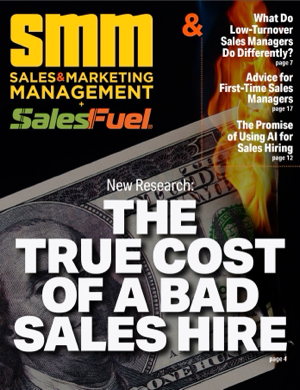

New Research: The True Cost of a Bad Sales Hire
June 2026

This free item is only available for logged in members.

Description

Hiring a salesperson feels like a growth decision. You’re investing in revenue, momentum and market expansion. But when that hire goes wrong, the impact isn’t just disappointing — it’s expensive, disruptive and often far- reaching in ways that leaders underestimate.

A bad sales hire doesn’t simply fail to produce. They actively drain resources, distort forecasts, and can damage your brand. Let’s break down what this means.


We also recommend this webinar...

Paul nolan
Salesfuel 18 copy   lee smith
Kathy crosett 2026 922x922
Join Paul Nolan, Editor of Sales+Marketing Management, C. Lee Smith, Founder and CEO of SalesFuel, and Kathy Crosett, SVP of Research at SalesFuel, for a moderated discussion on what the latest data reveals about a problem that hasn’t gotten easier to solve:
  • Bad hires don’t just underperform - they distort forecasts, damage customer relationships, and erode team morale
  • The typical hiring process consumes nearly three months before a new rep makes their first call
  • New reps then require an additional five-and-a-half months to reach the performance level of peers
  • By the time a manager acts, the damage is already compounding - and the team knows it before the manager does

But knowing the cost is only half the battle. The research also points to a clear path forward - and a surprising gap in how low-turnover companies hire compared to those with revolving doors. 

In this session, you’ll learn:
  • The difference between direct costs (recruiting, onboarding, training) and the hidden costs most leaders never calculate
  • Why managers consistently wait too long to address poor performance - and the organizational dynamics that cause it
  • What the data reveals about how high- and low-turnover companies approach the hiring process differently
  • How to build a more objective hiring process that protects your team, your culture, and your revenue

Reserve your spot now and be among the first to see research that updates a decade-old benchmark - with data that could change how your organization hires and performs.